
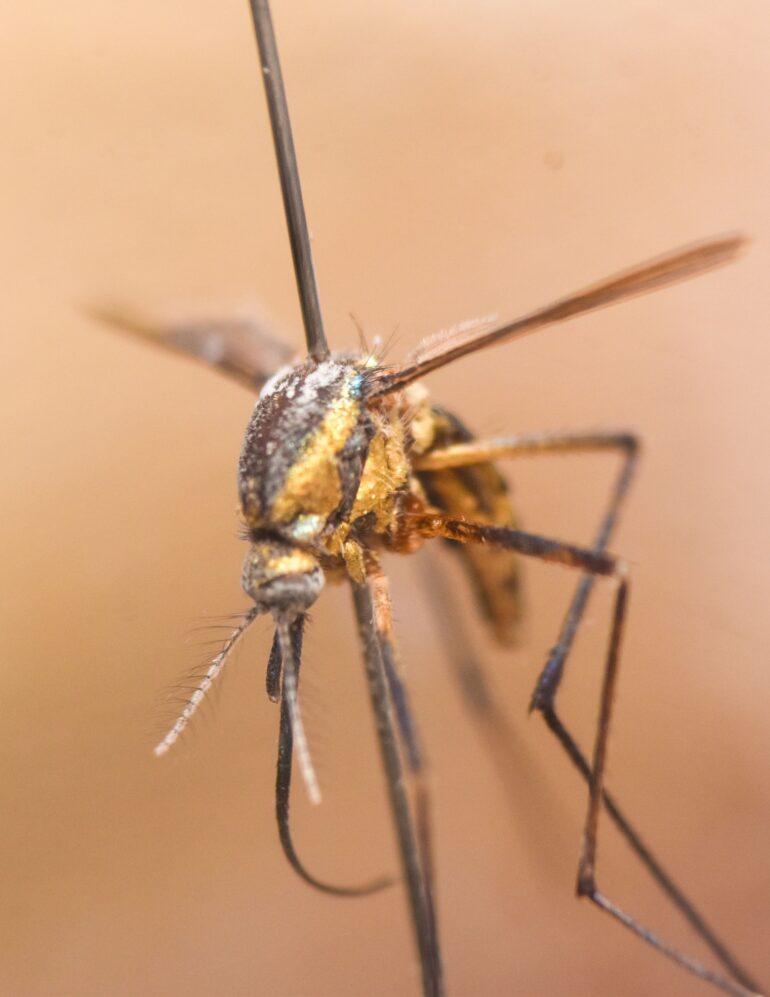
Mosquitoes, often underestimated, are one of the deadliest animals on the planet. Their impact on human society is staggering—shaping public health, economies, and even the course of history. Recently, San Diego has seen a concerning spike in mosquito populations as the Aedes Aegypti (Ae. Aegypti) mosquito, an invasive species, has entered the area, raising alarms for potential increases in mosquito-borne diseases.1 However, not all mosquitoes have a taste for human blood. Of the 3,500 mosquito species that exist today, only a few have evolved to specialize in biting humans. Understanding how these species diverged from others to become human-specialists—and whether their numbers could continue to rise—is crucial. Considering the rise of human-specialist mosquitos, and its potential for future disease outbreaks, there is a need for researchers to better understand these species and take the necessary steps to prepare for their further spread. As humans transform the world through expanding cities and inducing climate change, the evolving resilience of mosquitoes reveals nature’s persistent ability to adapt and push back.
Development of an Invasive Species
Firstly, there are many reasons why mosquitoes are such an effective disease vector in comparison to other animals. Female mosquitoes require blood feeding to nourish their eggs, making these host interactions highly frequent. Some mosquito species also have a large flight range of up to three miles, allowing them to expand their range for finding and passing on diseases.2, 3 Biologically, what allows a mosquito to function as a disease vector is their ability to successfully hold an arbovirus before transmitting it to another human in their future blood meals. Arboviruses, like the Zika virus, are viruses that are passed to a vertebrate from the bite of an arthropod, such as a mosquito.
After an arbovirus infects the mosquito, it develops and infects its salivary glands. Saliva is then injected into a human when the mosquito feeds, passing on the virus . However, many arboviruses, such as West Nile Virus, have co-evolved with a specific mosquito species (Culex in this case) to optimize its life cycle around that particular mosquito. This coevolution makes certain mosquitoes more effective at transmitting certain arboviruses than others.4
The Ae. Aegypti mosquito is one of the most studied human-specialist mosquitoes acting as arbovirus vectors, affecting around 700 million people annually due to diseases like dengue, Zika, chikungunya, and yellow fever.5 The invasive form of this species originates from the Sahel region directly south of the Sahara desert, a semi-arid region that acts as a transition between the desert and savanna. Over 5,000 years ago, the ancestors of Ae. Aegypti thrived in pools of water within the then wetter and more lush landscape of the Sahel region.
These stagnant pools of water are critical to the mosquito life cycle, serving as the primary breeding sites where females lay their eggs. The eggs hatch into larvae, which remain aquatic and feed on organic matter in the water until they mature into adults.. The abundance of natural water pools in the ancient Sahel likely provided ample breeding grounds for Ae. Aegypti ancestors. These mosquitoes thus acted as generalists, living in tree holes and rock pools and feeding on a broad range of species, both human and non-human.
However, a few thousand years ago, the Sahel underwent a dramatic drying event and transformed into the arid desert it is today, receiving only three months of annual rainfall. This ecological shift rendered the region inhospitable for the ancestors of Ae. Aegypti, due to their lifecycle revolving around stagnant water pools. Water stored by human societies for agricultural practices was now the only year-round reliable water source. Due to this acute shift in its habitat, Ae.Aegypt had to evolve to favor different kinds of hosts. “Hosts,” in this case humans, are a group of organisms that mosquitoes rely on for blood and, therefore, reproduction. Due to their newly increased proximity, humans became the most available host and shifted Ae. Aegypti into a new ecological niche. Over time, this adaptation led to the distinct human-specialist population of Ae. Aegypti, now genetically suited to thrive in human-dominated environments.
Global trade and urbanization further led to the spread of this human-specialized species outside of just the Sahel. For example, during the Atlantic Slave Trade, many water kegs were stored upon ships. Ae. Aegypti mosquitoes naturally gravitated to still water in these kegs, allowing the slave trade to facilitate distribution of these mosquitoes out of Africa. The mosquitoes’ close relationship with human populations enabled it to thrive in urban environments, further establishing its role as a vector for disease.6
Ecological Niche of Invasive Ae. Aegypti
Researchers are now intrigued by how the human-specialist Ae. Aegypti differ from generalist mosquitoes in their risk of disease transmission. Dr. Noah Rose, a researcher in the Department of Ecology, Behavior, and Evolution at UC San Diego, was working on a research project in the Cook Islands. However, progress was continuously interrupted by outbreaks of mosquito-borne infections in the region that posed a threat to the team. Dr. Rose grew curious of how such a small insect could pose such an immense obstacle to humans and refocused the scope of his research towards understanding the evolution of human-specialist mosquitos. 10
This research from the Rose Lab has shed light on the specific reasons for why certain mosquito populations prefer feeding on human populations over others. Major factors driving this preference are urbanization and climate change, which extend dry seasons and allows human-specialist mosquitoes to outcompete generalist species due to their usage of man-made water sources. As more regions urbanize, particularly in Africa, mosquitoes that once only thrived in natural environments are increasingly adapting to human-dominated landscapes. Urbanization fragments original habitats and reduces natural breeding grounds, forcing Ae. Aegypti to exploit human-made water sources just as Ae.Aegypti responded to the drying of the Sahel.
In addition to ecological factors, one significant behavioral trait that enhances Ae. Aegypti‘s human preference is its heightened attraction to human pheromones. The primary method for detecting humans are specialized nerve cells, called cpA neurons, with receptors designed to detect carbon dioxide, allowing them to sense the air humans exhale. However, mosquitoes are also attracted to humans, and specifically their skin, even in the absence of carbon dioxide. To determine how mosquitoes are able to detect human skin, researchers at UC Riverside constructed an experiment where they briefly exposed mosquitoes to a chemical that blocked their carbon dioxide receptors, rendering them unable to respond to exhaled carbon dioxide.7 Then, t test their attraction to skin pheromones, the team placed the mosquitoes in a wind tunnel with glass beads infused with the scent of human foot odor, obtained by wearing socks over the beads for several hours. After exposure to the receptor-blocking chemical, Ae. Aegypti mosquitoes showed significantly reduced attraction to the scented beads. These results demonstrated that the cpA receptors are not only able to detect carbon dioxide but also play a key role in sensing human skin pheromones.
In a related study by Princeton researcher Dr. Lindy McBride, mosquitoes were given the choice between entering a compartment with a human or guinea pig scent. McBride found that invasive Ae. Aegypti mosquitoes would fly towards the human scent 90% of the time.8 Curious as to the factors that determine weather a mosquitoes would prefer a human scent over an animal scent, Dr.Rose conducted his own study. He and his team sought to collect mosquitoes from twenty-seven different locations in Sub-Saharan Africa with varying human population densities and climates, including highly seasonal and semi-arid. Dr. Rose hoped that this wide sampling would give clues as to the types of environments human-specialist mosquitoes tend to thrive in, hypothesizing that distance from large human populations and weather being good potential indicators. Egg traps were placed in heaps of plastic and concrete in some locations and within shrubbery in others, attempting to capture a wide range of genetic and behavioral diversity within Ae. Aegypti populations for this experiment.
The captured mosquitoes were then tested for odor preference on an olfactometer, as seen ini figure one, which observed a mosquito’s preference for scents between a single human and two guinea pigs.8 Preference for a certain odor was then determined by the amount of time a mosquito spent in a particular arm. Results showed that human-specialist species spent much more time in the arm holding the human odor rather than that of the guinea pigs.These findings were then further supported when the researched used a different human subject and quails to ensure accurate results. A linear model developed from these results showed that the number of humans living within a twenty to fifty kilometer radius from the mosquito collection site was a strong predictor of preference. Specifically, the model identified that as population density increased, so did preference for human scent.9
Climate variables were also determined to explain 65% of mosquito preference, with a longer dry season showing strong correlation with preference for human scent.9 Among these climate variables, low precipitation levels during the warmest season were the strongest predicting factors for human-specialist mosquitoes. Dr. Rose and his team believe that these two factors together highlight the struggle mosquitoes face during longer dry seasons and why some have evolved to be human-specialists. While eggs in continuous wet conditions can hatch immediately, those laid at the end of the rainy season and in regions with extensive dry periods must pause their development to survive these extended dry periods. However, human-stored water, such as that shown in figure 2, provides a wet habitat that lasts year round even in harsh climates, allowing for the development of larvae regardless of environmental constraints.
Dr. Rose’s study highlights a significant distinction between human-specialist mosquitoes and generalist species, particularly in their scent preferences and egg-laying behaviors. human-specialist groups sacrifice access to more organic material to consume, in order to survive a longer dry season. This underscores a clear behavioral divergence between the two groups, as generalist species favor natural, bacteria-rich pools that signal abundant food for their larvae. Generalist mosquitoes also develop slightly faster as larvae, possibly due to the greater predation risks in their more dangerous natural habitats. This speed gives them a survival advantage in environments with higher predator pressure, allowing them to mature before they are consumed. However, this increased speed would not impact human-specialist species, who tend to live in different areas than generalist species. 10 This contrast in habitat preference, development speed, and survival strategies highlights the evolutionary trade-offs that shape mosquito behavior, reinforcing the distinct ecological roles of human-specialist and generalist species.
Response to Risks
These insights into mosquito behavior and adaptation are not only critical for understanding their evolutionary path but also have significant public health implications. With climate change altering habitats and extending dry seasons, regions that previously did not see human-specialist mosquitoes may begin to experience an influx of Ae. Aegypti and other populations, such as Culex. This shift increases the risk of disease spread in urbanizing regions, most notably Africa. Diseases that have historically had less of an impact in Africa, such as yellow fever, could now become more widespread as Ae. Aegypti enter cities. Understanding the genetic, behavioral, and environmental factors that influence mosquito preference for human hosts helps researchers predict which species may evolve similar behaviors in the future, potentially allowing for proactive control measures.
Currently, the Rose Lab uses technological advances, such as gene-editing techniques like CRISPR, to investigate methods of mitigating the threat posed by human-specialist mosquitoes. Broadly, CRISPR uses a guide RNA to find a particular sequence of DNA and then uses the Cas9 enzyme to cut the DNA at that location.11 The Rose Lab utilizes this technology to selectively knock out, or inactivate, regions in the genomes of human-specialist mosquitoes and observe its effects on preference of host. The ultimate goal of this research focus is to gain an understanding of the genomic regions of human-specialist mosquitoes that contribute to their unique nature.
It has become clear that the territories of human-specialist mosquitoes will continue to expand in the coming years. In fact, the problem is closer than many think, as the invasive Ae. Aegypti has now reached San Diego. These mosquitoes introduce various new threats to the environment and highlight the need for quick action. Ae.Aegyti threatens the health of millions. Without an effective method of intervention, it’s clear that the invasive human-specialized Ae. Aegypti can profoundly impact the health and livelihoods of millions worldwide. As individuals, and as a society, it is critical to take action to curb their spread—whether through innovative technologies, public health initiatives, or personal efforts to reduce mosquito breeding grounds.
Sources:
- Invasive Aedes mosquitoes. County of San Diego. [accessed 2024 Dec 5]. https://www.sandiegocounty.gov/content/sdc/deh/pests/aedes.html
- Mosquitoes. Medical Entomology. [accessed 2024 Dec 5]. https://extension.entm.purdue.edu/publichealth/diseases/mosquito.html.
- County C. Mosquito control. Chatham County Mosquito Control Department. [accessed 2024 Dec 5]. https://mosquitocontrol.chathamcountyga.gov/Faq/MosquitoFAQs.
- Lewis J, Gallichotte EN, Randall J, Glass A, Foy BD, Ebel GD, Kading RC. Intrinsic factors driving mosquito vector competence and viral evolution: A Review. Frontiers. 2023 Dec 8 [accessed 2025 Jan 5]. https://www.frontiersin.org/journals/cellular-and-infection-microbiology/articles/10.3389/fcimb.2023.1330600/full.
- Piovezan-Borges AC, Valente-Neto F, Urbieta GL, Laurence SGW, Roque F de O. Global trends in research on the effects of climate change on Aedes Aegypti: International Collaboration has increased, but some critical countries lag behind – parasites & vectors. BioMed Central. 2022 Sep 29 [accessed 2025 Feb 24]. https://parasitesandvectors.biomedcentral.com/articles/10.1186/s13071-022-05473-7.
- Sokol J. Slave trade records help reveal when first yellow fever mosquitoes bit humans. Science. 2023 Mar 27 [accessed 2024]. https://www.science.org/content/article/slave-trade-records-help-reveal-when-first-yellow-fever-mosquitoes-bit-humans.
- How mosquitoes detect people. National Institutes of Health. 2022 Oct 26 [accessed 2025 Jan 5]. https://www.nih.gov/news-events/nih-research-matters/how-mosquitoes-detect-people.
8. Fuller Wright L. Why do mosquitoes choose us? Lindy McBride is on the case. Princeton University. 2018 [accessed 2025 Jan 5]. https://www.princeton.edu/news/2018/10/23/why-do-mosquitoes-choose-us-lindy-mcbride-case.